

The skilled trades shortage isn?t just a labor crisis. It?s an open door, and a case for rethinking what a good career actually looks like.
Here?s a story that plays out more often than most people want to admit.
Someone graduates high school, gets told college is the path to a stable life, takes out $60,000 in loans, spends four years studying something they liked in theory, and graduates into a job market that wants three years of experience they don?t have. By 30, they?re underemployed, paying off debt, and wondering how they ended up here.
Meanwhile, someone else took a different road. They went to trade school for 18 months, got into an apprenticeship, and by that same age, they?re debt-free, licensed, and billing $85 an hour on a service call.
This isn?t a knock on education. It?s a question worth asking out loud: why didn?t anyone tell us there were two roads?
For most people, the answer is simple: nobody in their life had taken that road. There was no one to sit across from them and say, ?I know this feels like starting over, but here?s what I actually know about what that first year looks like.? That kind of conversation, peer to peer, no sales pitch, no agenda, is rarer than it should be. And its absence shapes careers in ways we rarely talk about.
Mentorship in the trades is not a new idea. It is, in fact, the original model. Every licensed plumber, electrician, and HVAC tech got there by working alongside someone who already knew. The apprenticeship system exists because there is no substitute for learning from a person who has done it. What is missing, too often, is the front end: the conversation that happens before someone ever picks up a tool. The one that helps them see the road at all.
The U.S. construction industry needed to attract about 439,000 new workers in 2025 to meet demand. In 2026, that forecast rises to nearly 499,000.
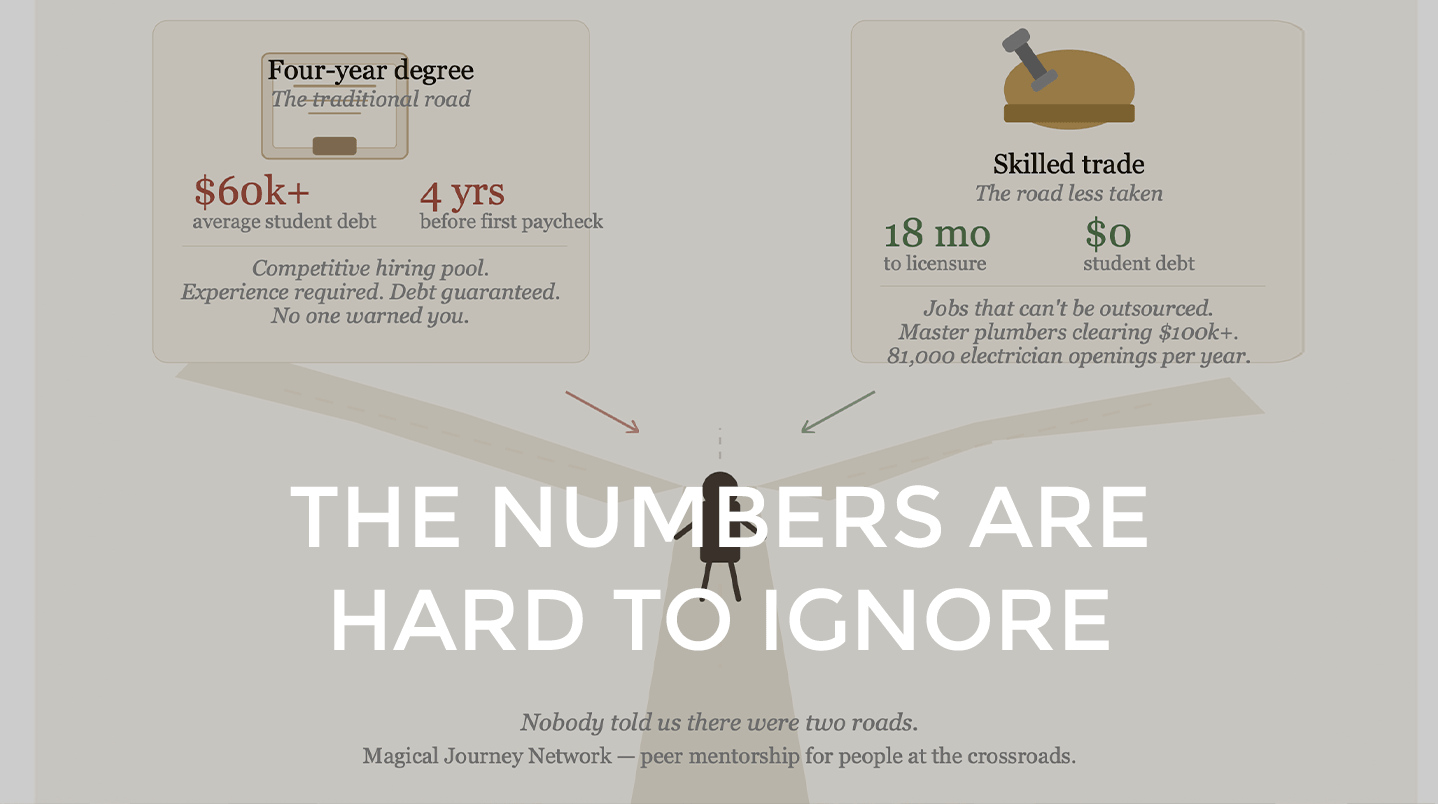
The Numbers Are Hard to Ignore
The skilled trades shortage is not a slow burn. It is a structural crisis that is reshaping wages, timelines, and entire industries. The Bureau of Labor Statistics projects electrician employment to grow 9% through 2034, with roughly 81,000 openings per year. Plumbers and pipefitters add another 44,000 annual openings. HVAC mechanics and installers are expected to grow 8%, adding more than 40,000 openings every year over the same period.
As of mid-2025, more than 300,000 of those positions sat unfilled. A National Association of Home Builders study put the economic cost of the housing labor shortage at $10.8 billion per year, roughly 19,000 homes that don?t get built.
The shortage has done something unexpected to wages. Master plumbers in commercial work can earn well above $100,000, with top earners running their own shops clearing $200,000 or more. Senior commercial electricians with journeyman or master status are seeing similar ranges. These are not ceiling numbers. For many tradespeople in the right markets, they are the new floor.
And yet, a Harris poll found that only 38% of Gen Z believes skilled trades offer the best career opportunities, and only 36% strongly agree that trades offer a faster, more affordable path to a good career.
That gap between what the data shows and what young people believe is not an accident. It is the result of decades of messaging that pointed an entire generation toward four-year degrees as the only legitimate path forward.
A career in the trades doesn?t get shipped overseas. It doesn?t get replaced by an algorithm. And it doesn?t require you to start $60,000 in debt.

What No One Talks About: The Small Shop Problem
The shortage gets talked about at the industry level, big contractors, union halls, national workforce reports. But the part that rarely makes the news is what it looks like for the small shop.
Think about the plumber who built a solid residential business over 30 years. He knows every quirk in every pipe under half the homes in his area. He has a loyal customer base, a good reputation, and a problem: he?s 61, his knees are shot, and he has nobody to hand this to.
These mom-and-pop operations, the two-truck plumbing company, the family HVAC shop, the independent mechanic who has worked on every car on his block, are sitting on decades of practical knowledge with no structured way to pass it down. They can?t compete with union wages on compensation. They don?t have HR departments to run recruiting pipelines. And most of them have never heard of a pre-apprenticeship program.
What they do have is the most valuable thing in any trade: lived experience, and the willingness to teach someone who shows up and pays attention.
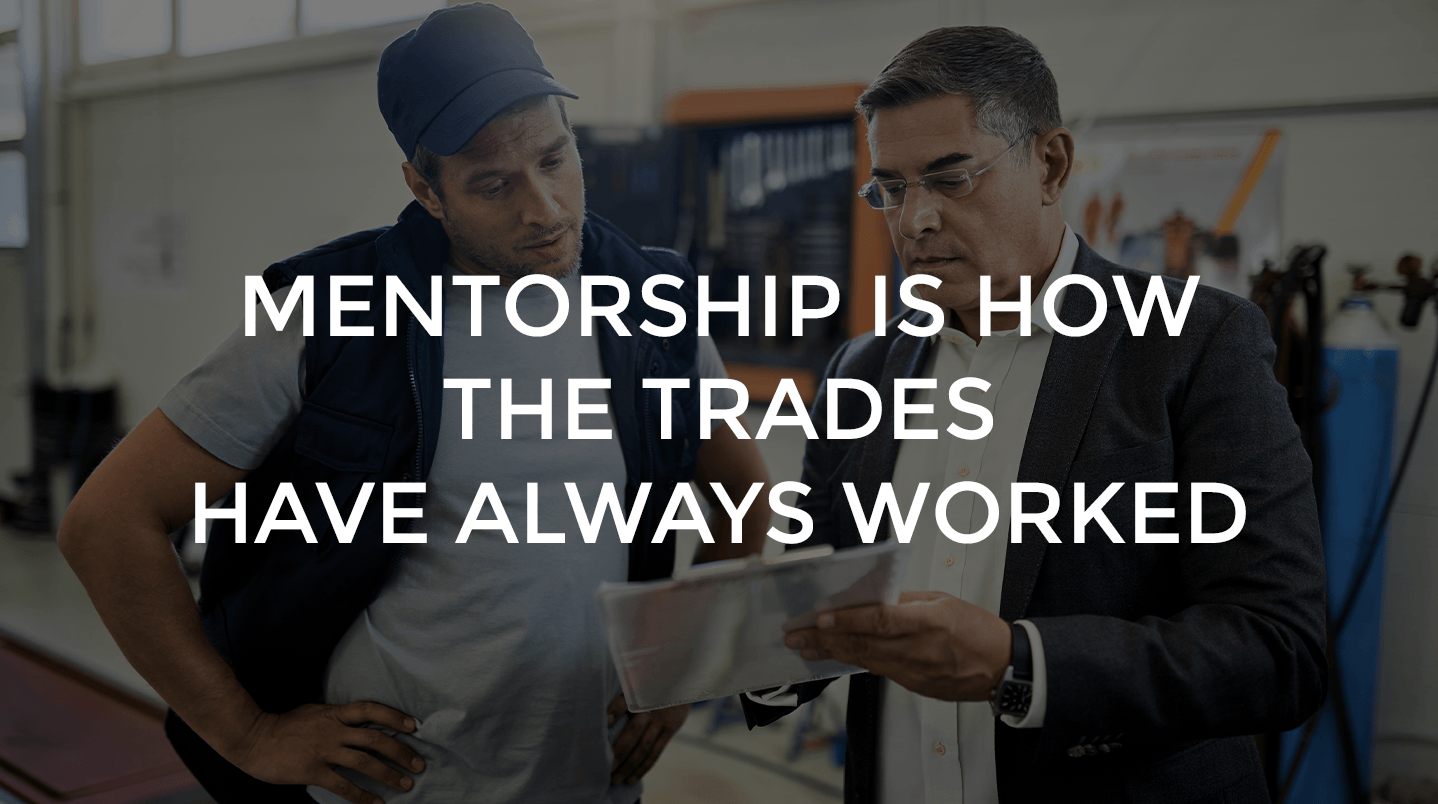
Mentorship Is How the Trades Have Always Worked
There is no textbook that teaches you the way a particular brand of HVAC unit sounds when the capacitor is going. There is no online course that shows you how a drain looks when the problem is three feet upstream from where everyone assumes it is. That knowledge lives in people, in the hands, in the memory, in the way an experienced tech moves through a job.
The trades have always been built on mentorship. Apprenticeship is not a new concept, it is the original model. You learn by working alongside someone who already knows. You earn your credential by accumulating hours under supervision. The credential, when it comes, means something because the work behind it was real.
That model works. The problem is the front end: getting the right people into the room with the right mentor in the first place.
Plenty of people in their 30s and 40s would make excellent electricians or plumbers. They are capable, they are motivated, they have work ethic that a 22-year-old is still building. What they often lack is a connection to the industry, a way in, a person who can tell them whether it is right for them, and a guide through the first uncertain months of a major career change.
The small shop doesn?t need an HR department. It needs one person who?s navigated a career change to sit across from one person who?s thinking about making one.

Where MJN Fits In
Magical Journey Network, Inc. was built for people in exactly that position, not the person who has everything figured out, but the person who is standing at a crossroads and needs someone who has been there before.
Peer mentorship is what we do. Not career counseling. Not job placement. Someone who has made a significant life or career transition, sitting across from someone who is considering one, sharing what they actually know.
For the trades specifically, that means connecting people who are underemployed, burned out, or simply ready for something different with mentors who have made the shift, or who have spent careers in the trades and can tell you honestly what the first year looks like.
It also means building a bridge to the small shops that want a pipeline but do not know how to build one. A retired plumber who loves talking about the trade does not need to become a formal apprenticeship sponsor. He just needs a way to find the person worth talking to.
That is a connection problem. And connection problems are what peer mentorship solves.
Are you considering a move into the trades, or do you have trade experience worth sharing?
We want to hear from both sides of that conversation. Reach out at contact@magicaljourneynetwork.com or visit us at magicaljourneynetwork.com to learn more about the mentorship program.
Magical Journey Network, Inc. is a Florida nonprofit corporation (EIN 41-4710315) with 501(c)(3) status pending. Donations are not currently tax-deductible.